
An Agentic Commerce Reality Check
Guest author Andrew Lipsman of Media, Ads & Commerce puts three recent agentic commerce headline findings to the test

Today I’m welcoming Andrew Lipsman, my former eMarketer analyst colleague, to The AI Ad Economy. You might know Andrew from his prediction that retail media would become “digital advertising’s third big wave.” Or from his now-legendary eMarketer chart (check out the previous link). Or more recently, for his presentation at Marketecture Live, “𝗪𝗵𝗲𝗻 𝘁𝗵𝗲 𝗝𝘂𝗶𝗰𝗲𝗿𝗼 𝗜𝘀 𝗡𝗼𝘁 𝗪𝗼𝗿𝘁𝗵 𝘁𝗵𝗲 𝗦𝗾𝘂𝗲𝗲𝘇𝗲”. Or maybe this is your introduction to his mythbusting, research-led analysis. Either way, I’m a big believer in healthy debate and alternate POVs about the growth of AI in marketing and commerce, so I was thrilled when he agreed to let me publish one of his subscription-only Substack articles for free.
If you want more from Andrew in your inbox (which you should!), I encourage you to subscribe to his Substack Media, Ads & Commerce here.
PS: Because I wanted you to be able to read Andrew’s full article, I’m skipping the Numbers and Headlines sections of this week’s newsletter. They’ll be back next week.
THE MAIN STORY
An Agentic Commerce Reality Check (guest post by Andrew Lipsman)
I’ve previously described agentic commerce as a “collective hallucination”—a not-so-popular characterization among the pro-agentic crowd.
The most famous examples from history are the Dancing Plague of 1518, the Salem Witch Trials, and the Mad Gasser of Mattoon. Collective hallucinations don’t arise out of thin air—rather, they manifest within communities subject to intense external stress, high suggestibility, and social contagion.
In late fall 2025, all three converged in retail and ecommerce. Retailers were under growing pressure to squeeze more revenue from retail media networks, even as performance gains became harder to sustain. At the same time, the surging adoption of AI search made the idea of “agentic commerce” sound not just plausible but inevitable—a narrative too compelling for an anxious industry to resist. The Fall conference season echo chamber—amplified on LinkedIn—converted speculation into conviction almost overnight.
The sentiment soon crystallized as every major consulting firm weighed in with its prognosis of retailers’ existential risk:
Kearney (Aug 2025): Agentic Commerce: From Brand Loyalty to Bot Logic
“Agentic commerce will be the most disruptive retail shift since e-commerce. 60% of consumers expect to use AI agents for shopping within the next 12 months. The real threat comes from cross-platform ‘super agents’ that sit between retailers and consumers. For unprepared retailers, the risk is up to 500 bps EBIT erosion from margin compression, traffic dispersion, and brand commoditization.”
BCG (Oct 2025): Agentic Commerce is Redefining Retail – How to Respond
“The advancements in agentic shopping present substantial challenges for traditional retailers, primarily through risks associated with disintermediation… The growth of zero-click search and agent-driven interactions is eroding direct traffic—along with the retailer’s ability to observe, influence, and understand consumer behavior at scale… AI agents’ emphasis on utility weakens traditional brand loyalty, limits cross-selling opportunities, and puts retail media revenues under pressure, all while intensifying the race to the bottom on price and delivery speed.”
McKinsey (Oct 2025): The Agentic Commerce Opportunity: How AI agents are Ushering in a New Era for Consumers and Merchants
“Agentic commerce also threatens to bring about a decline in traditional revenue streams, particularly from advertising. Retail media networks, which rely on ad-based models, could face challenges as consumers shift toward agent-driven experiences that bypass traditional ad channels.”
Bain (Nov 2025): Agentic AI Poised to Disrupt Retail, Even With 50% of Consumers Cautious on Fully Autonomous Purchases
“Of the three types of AI agents – third-party ‘objective’ agents (e.g. ChatGPT, Perplexity), on-site retailer agents, and off-site retailer agents – third-party agents threaten to disintermediate retailers most.”
The result was a near-industry-wide belief that agentic commerce would rewrite the rules of retail within months. An ongoing array of headline-grabbing charts and statistics have only added fuel to the fire.
But few of these stats stand up to scrutiny.

So, as with any hallucination, what feels visceral and real in the moment warrants a sober second look.
In this article, we’ll put three recent agentic commerce headline findings to the test.
HEADLINE 1: Adobe: Holiday Gen AI Ecommerce Referral Surged 693% vs. Prior Year
Throughout the 2025 holiday season, Adobe reported on various ecommerce sales and shopping trends. Garnering the most headlines this year wasn’t the increase in ecommerce spending but the dramatic rise in Gen AI referral traffic: “Generative AI tools drove a 693.4% increase in traffic to retail sites”.
The implication was clear: that AI shopping is a megatrend increasingly influential to the record $257 billion in US holiday ecommerce spending.
I received pitches from Adobe’s PR firm throughout the season highlighting the growth rates. On at least one occasion, I asked what the basis of the growth rate was but never received the relevant supporting data. While ~700% growth might sound impressive, year-over-year growth rates like that tend to only occur from a very small base.
At the close of the season, my curiosity led me to check another reliable source for web traffic: Sensor Tower. This data provided the clarity needed to put this trend in context, revealing that Gen AI referral numbers increased from 0.1% of traffic to 0.6% between Holiday 2024 and Holiday 2025.
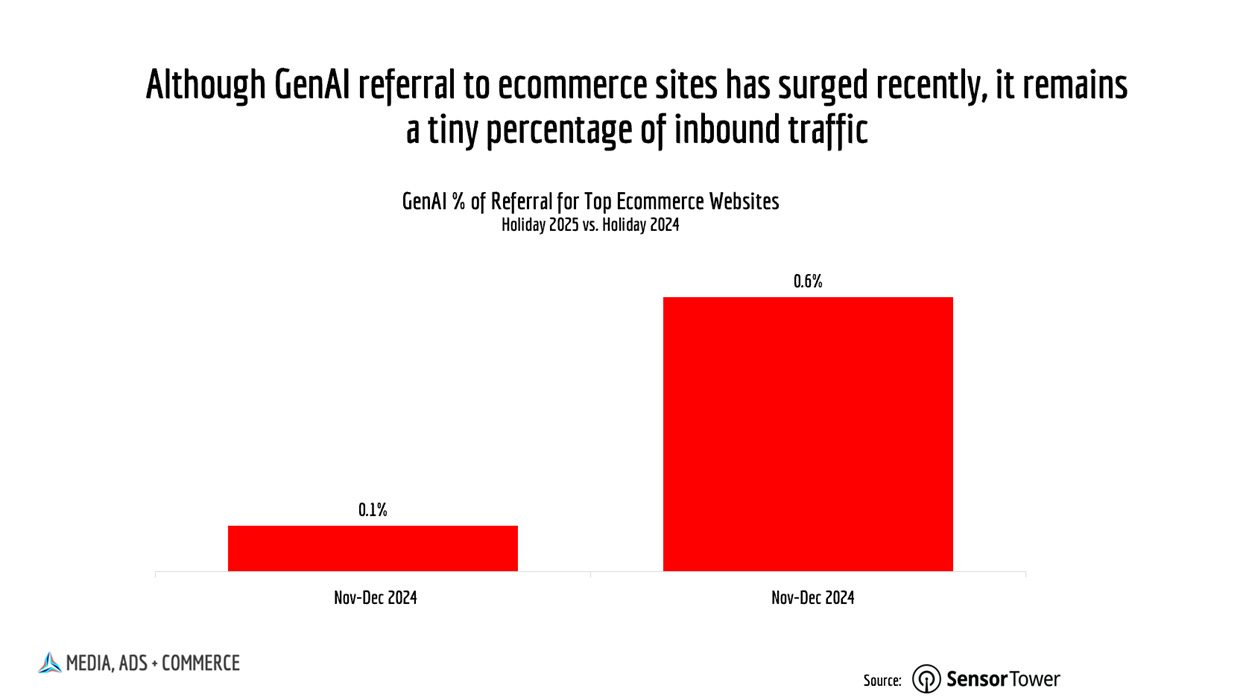
The overall growth rate in this traffic jumped ~200%, an impressive number to be sure. (Not quite as high as Adobe’s estimate, but directionally similar—the difference likely explained by Adobe’s footprint of ecommerce sites not including Amazon and other large retailers.) And yet, the total Gen AI referral still barely registers in the overall composition of ecommerce traffic.
Adobe’s headlines weren’t inaccurate, but they did lack important context.
HEADLINE 2: Agentic Commerce is an Existential Risk to RMNs
One school of thought says that agentic capabilities will shift shopping to LLMs, drive ecommerce traffic to zero, and vaporize on-site retail media revenue in the process. And this will all happen by the end of the decade!
The directive is clear: retailers should forsake current initiatives—such as RMN buildouts—to adapt to this zero-traffic future.
Is this good advice? How should retailers assess the tradeoffs?
I decided to consult Emarketer, a reputable third-party source of forecast data, which has projections for retail/commerce media and agentic commerce through 2029. According to those estimates, “agentic commerce” (“AI platform on-site retail ecommerce sales”, per Emarketer) will reach $28 billion by that date. Meanwhile, commerce media ad spend will increase by $48 billion from its 2025 total. Thus, if retailers allocate resources based on the revenue potential, then retail media represents a bigger opportunity to pursue.
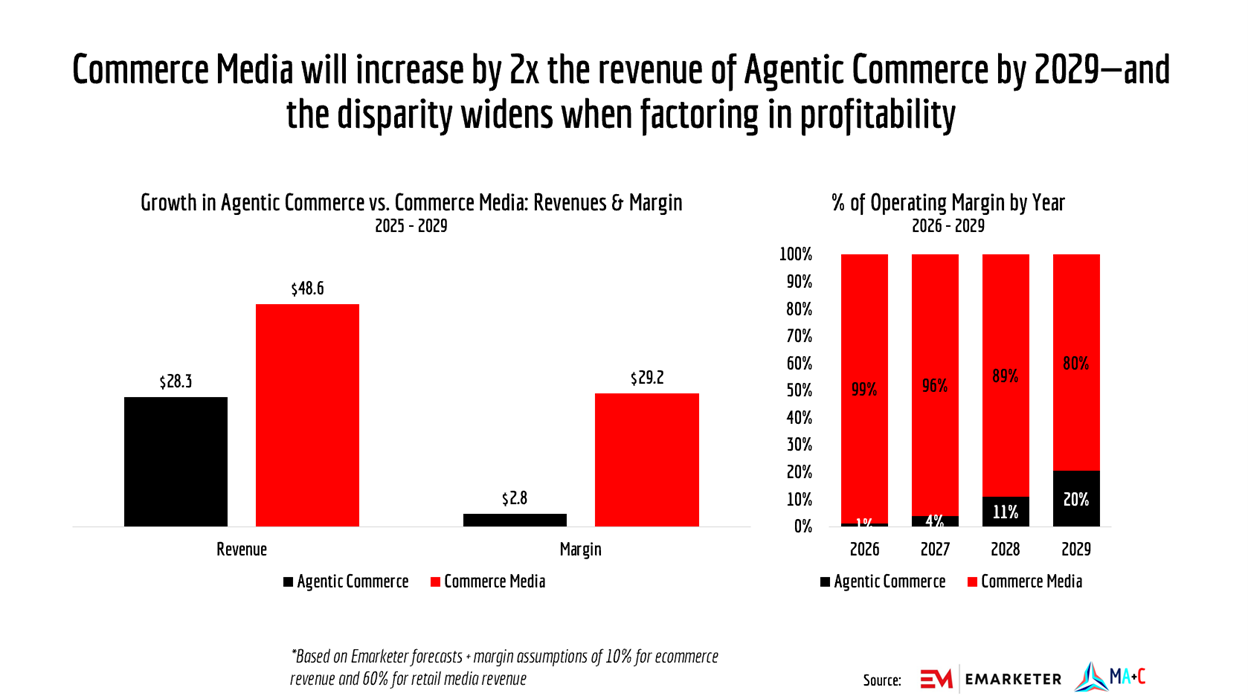
But retailers aren’t just accountable to revenue growth—their valuations depend on profits. And currently, ecommerce revenue on its own isn’t very profitable. In fact, many retailers are still in the red, and Walmart is only now going into the black on this channel. Meanwhile, retail media has huge gross margins—especially for O&O media like their ecommerce sites.
If we apply typical margins of 10% for ecommerce and 60% for retail media, the gap between the two opportunities gets more dramatic. Under this scenario, commerce media would produce $29 billion in operating margin vs. $2.8 billion for ecommerce occurring on AI platforms. (Feel free to use different margins assumptions, but the disparity will still be significant.)
There’s no way to predict this future with certainty, but retailers can make decisions rooted in rationality over hyperbole. And when you do the math, the answer should be clear.
HEADLINE 3: ChatGPT is Already the #2 Ecommerce Site
A chart began circulating on Linkedin late last year suggesting that ChatGPT’s meteoric rise as a commerce channel made it the #2 ecommerce site in web traffic after Amazon.
A back-of-the-napkin calculation used OpenAI’s self-reported stats of 2.5 billion prompts per day and 2.1% pertaining to purchasable products to get 52.2 million queries. This was then compared to Euromonitor’s US daily visits to Amazon, Walmart, Ebay and other leading retailers. Only Amazon topped 52.2 million.
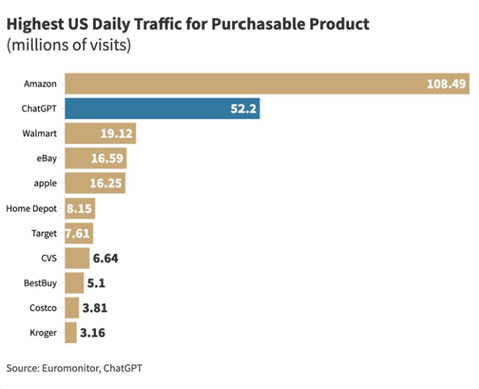
It made for a great headline—if only it were close to accurate.
A comparable analysis using Sensor Tower data—based on US visits/sessions for desktop, mobile web, and mobile app—painted quite a different picture. (ChatGPT visit data was similarly multiplied by 2.1% to estimate product-oriented traffic.)
Here’s what it showed:
Amazon traffic is 27x the size of ChatGPT’s product-oriented traffic.
Walmart, Ebay, Target, and Home Depot also top ChatGPT by healthy margins.
Google—which was conveniently omitted from the prior analysis—is bigger than all of them, including Amazon. (This was calculated based on total traffic multiplied by a reported 14.5% of searches being commercial.)
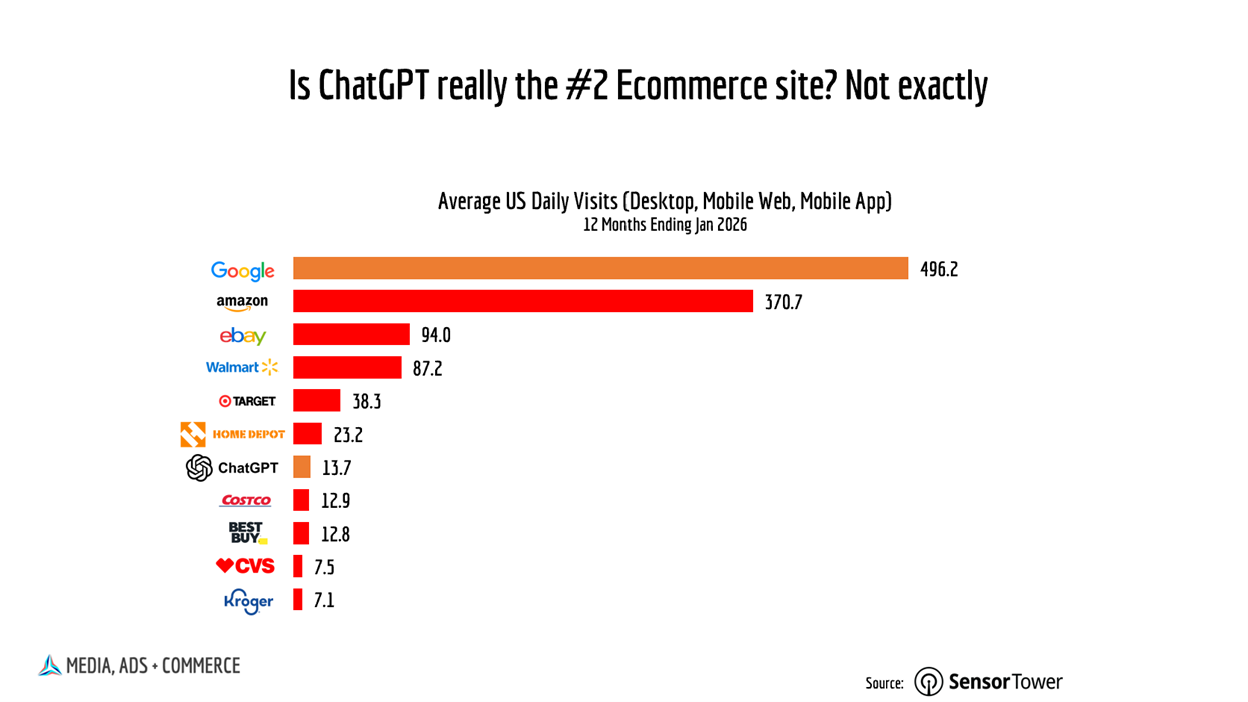
It’s probably not that useful to compare traffic for ecommerce sites to search and answer engines in the first place. But I get the point in drawing the comparison. However, what’s included shouldn’t be cherry-picked. If ChatGPT is included in this list, then Google should be too—and probably social media platforms, as well.
As coverage of AI and agentic commerce continues to intensify, sensational headlines will proliferate. Now more than ever, these headlines require a careful reading, a critical lens, and a grounding in facts.
Otherwise you’re just buying into belief. And when you believe too easily, you’re prone to hallucinate.
So don’t be surprised when you get burned.
THE NUMBERS BEHIND THE AI AD ECONOMY
Back next week!
HEADLINES
Back next week!
WHAT’S DEBBIE UP TO?
Podcasts
The AI Edge with U of Digital. It’s been a while since I did a purely news-driven podcast and this one was rapid-fire fun. U of Digital’s Shiv Gupta and Myles Younger and I debated whether Sam Altman is a liar, why Anthropic’s Mythos announcement might have been a marketing tactic, whether AEO/GEO has jumped the shark, and the two big developments in consumer behavior and advertising that will tell me if we’ve gotten to a social media-like turning point in AI. Catch it on YouTube, Apple podcasts or Spotify.
Retailgentic: I joined ReFiBuy’s Scot Wingo for a wide-ranging discussion about how AI is reshaping advertising and commerce and what brands should be doing now. Watch the full podcast here and check out the Retail Media Breakfast Club article above for even more!
Genuin: I recently sat down with CMO Matt Wurst for an episode of Genuin Connections. I first got to know Matt during his time at 360i, and it was a ton of fun to catch up and unpack the rapid rise of AI media and the AI advertising economy. Watch the full video here, but if you only have time for the highlights, here’s a clip I posted to LinkedIn.
Research
IAB + Sonata Insights: The AI Ad Gap Widens (read our 2024 study here)
Mediaocean: 2026 Advertising Outlook Report (I wrote the foreword)
On Stage
M Agency webinar, May 6, 2026, virtual. I’m joining senior leaders from M Agency for “AI and the Customer Journey: Make Your Brand Visible Where It Counts.” Register for the webinar here.
Skai’s ShopAble, May 13, 2026, New York City. I’ll be presenting “AI, Consumers & Commerce: A Reality Check.” RSVP at my personal link here.
Operative’s Inview 2026: The Media Intelligence Summit, May 14, 2026, New York City. I’m giving the opening keynote, “The AI Monetization Shift: Why Media Won’t Get 8 Years This Time.” Request an invitation to attend here.
AdExchanger’s Programmatic AI, May 19, 2026, Las Vegas. I’m delivering the opening keynote “Consumers Aren’t Where Ads Expect Them Anymore.” Use my code JOINME20 for 20% off your pass.
Path to Purchase Institute’s Retail Media Summit, June 3, 2026, Chicago. I’m delivering “Who Owns the Customer in the Age of AI-Fueled Commerce?”. Check out the agenda and register here.
Debra Aho Williamson is the Founder and Chief Analyst of Sonata Insights, where she helps advertisers navigate the next major structural shift in media: the rapid rise and monetization of AI platforms. Over nearly two decades as an analyst at EMARKETER, Debra was among the first to forecast the growth of social media advertising and identify how it would fundamentally reshape marketing investment.
Today, she applies that same pattern-recognition lens to AI, analyzing how consumer adoption is accelerating monetization and redefining brand budgets, media strategy and industry power dynamics. Through Sonata Insights, she partners with leading platforms, agencies and technology companies to deliver research, advisory and strategic narratives that bring clarity and credibility to this transition.