

It’s gray and cool in Seattle this week; the joke we always tell is that summer starts here on the 5th of July. But after the heat in Cannes last week, I’m OK with a little bit of cloud cover.
Here’s what’s inside The AI Ad Economy today:
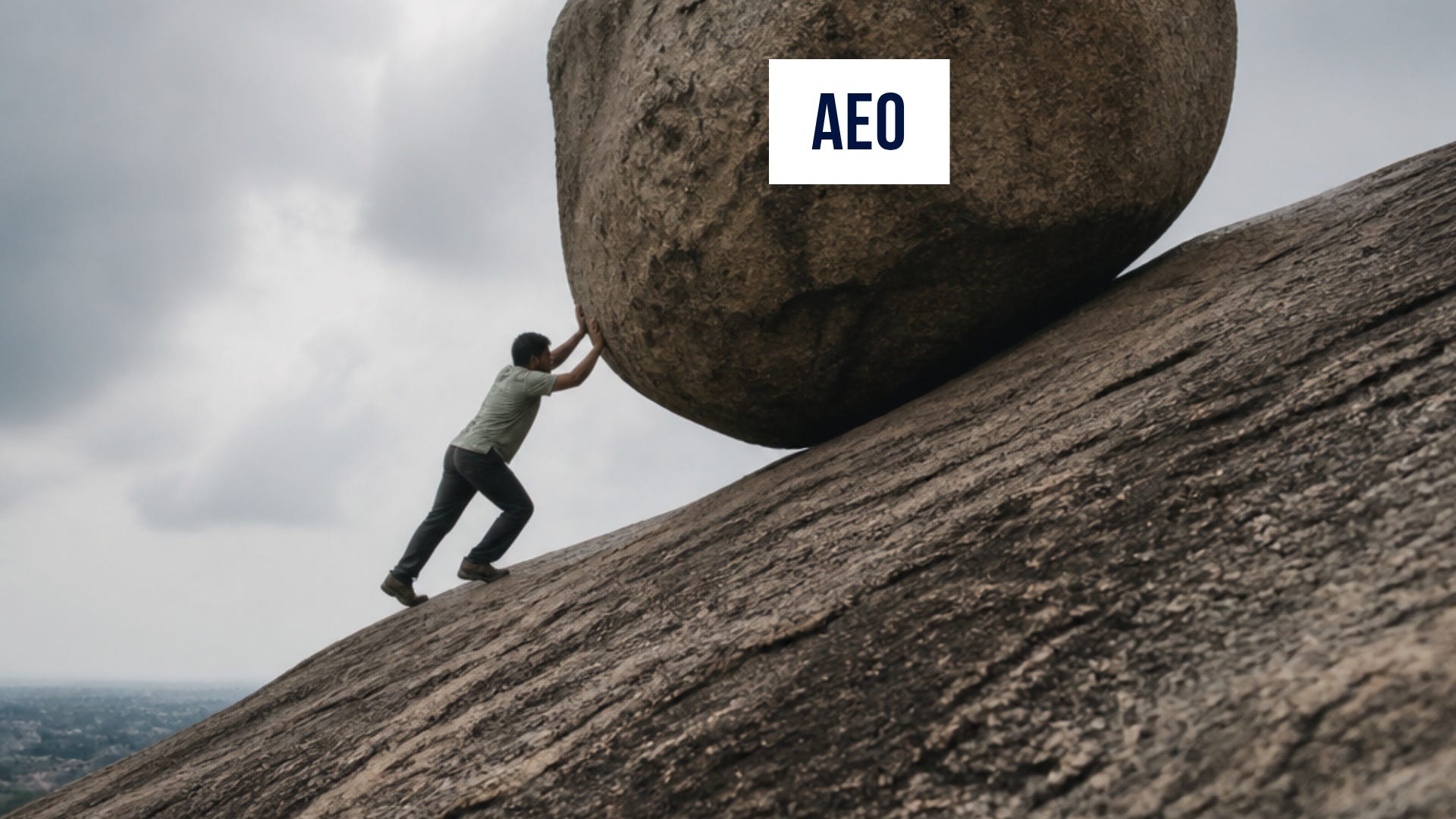
The hard questions marketers need to ask about AEO: Lately, I have been referring to AEO as a Sisyphean task. In Greek mythology, King Sisyphus angered the gods, and his punishment was to forever push a boulder up a hill, only to see it come crashing back down to the bottom. Imagine if the hill kept moving, the boulder kept changing shape and the gods never revealed the rules. That’s AEO today.
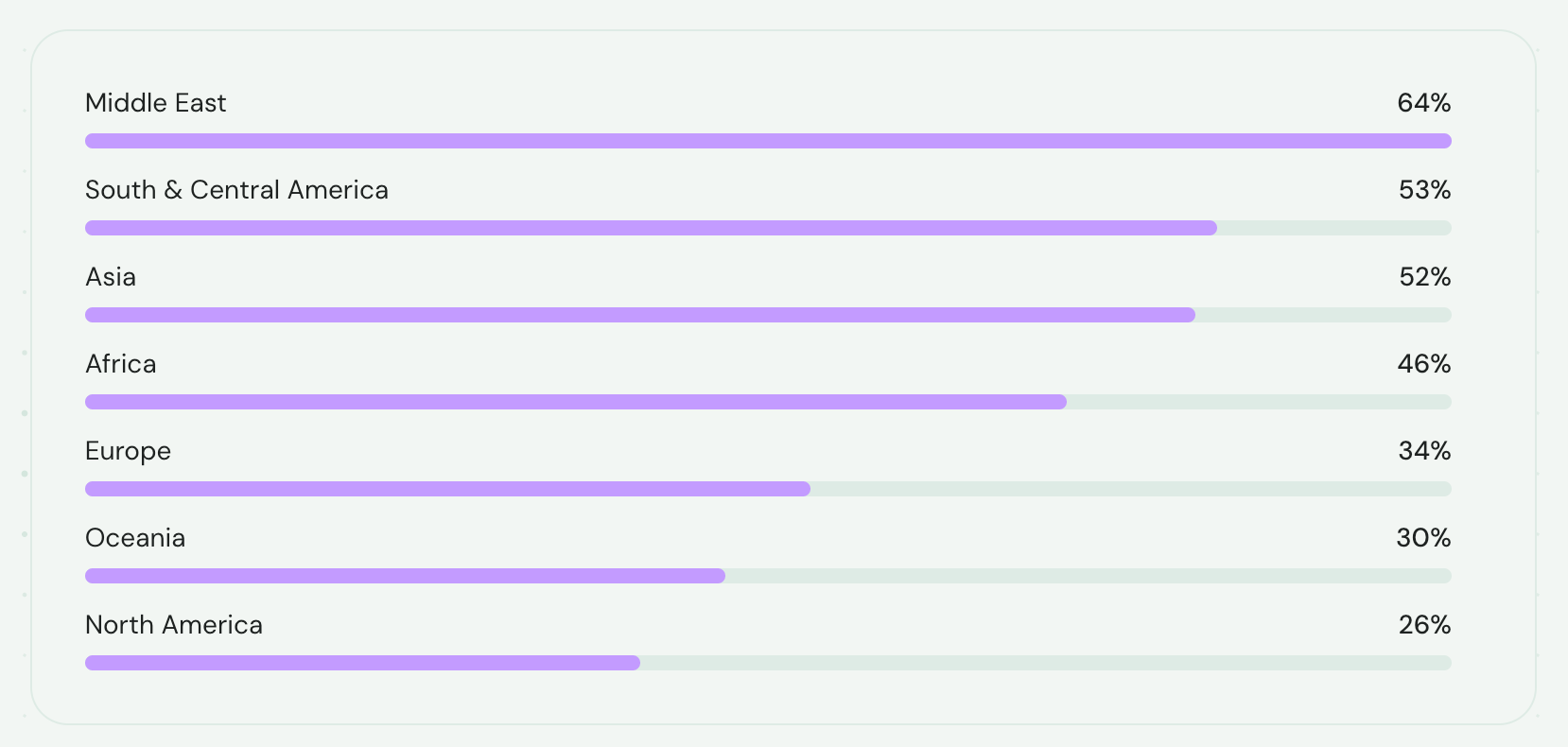
The numbers behind The AI Ad Economy: North America trails other world regions when it comes to trust in AI recommendations.
News of the week: Albertsons, Instacart eye ads in AI-infused experiences; brands contemplate AEO; ChatGPT ad dismissals drop 50%.
THE MAIN STORY
The Sisyphus Problem in AEO
“How do you influence an A.I. model?” That was the central question in Marty Swant’s New York Times article about Cannes Lions a few days ago. In it, he explored the implications for marketing when AI chatbots determine which brands and products show up.
It’s an important question. But the more I’ve been writing about the impact of AI on marketing and advertising, the more I think the bigger question isn’t “How do you influence AI?”
It’s this:
“Can anyone prove they know how to influence an AI model?”
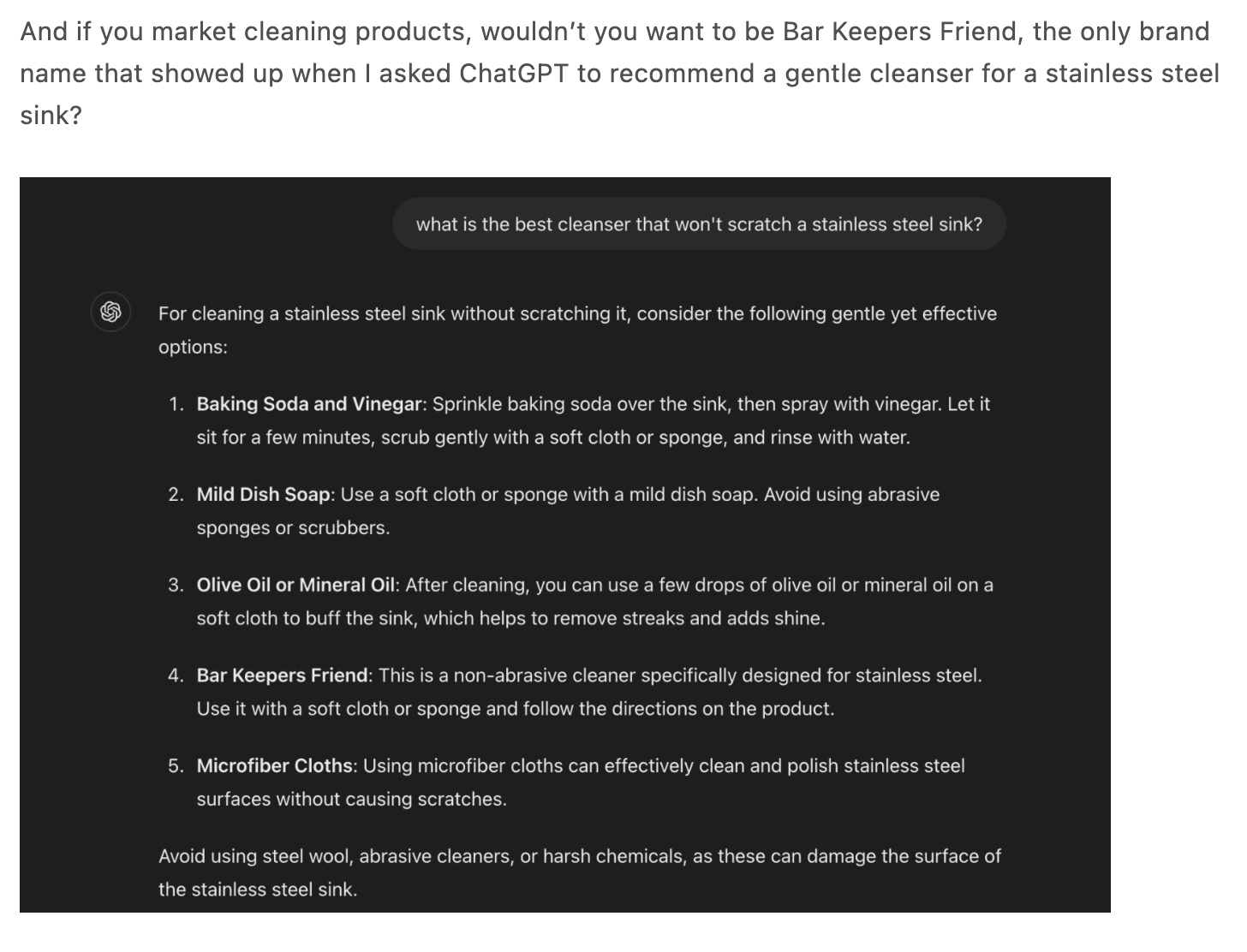
I first wrote about the importance of brands showing up in AI search results nearly two years ago, in a column for Procter & Gamble’s Signal 360 magazine (you can read it in the Wayback Machine).
Here’s the relevant excerpt:
Fast forward to last week, and answer engine optimization (AEO) was a hot topic during Cannes Lions.
At a luncheon I attended, a publishing executive raved about their company’s AEO offering as a way for client brands to get noticed by being associated with verified news content.
At a dinner hosted by Gumshoe.ai, an AI visibility platform, one conversation around the table was how to manage what already feels like an unending amount of work.
Profound, one of the largest companies in the AEO space, came to Cannes for the first time this year to pitch its services.
The presence of Profound at Cannes was a big deal for AEO. Here’s what CEO James Cadwallader wrote on LinkedIn this week:
“We had nearly 300 meetings last week with F500 CMOs, agency leaders, and the biggest marketing organizations in the world, all grappling with the same reality: AI is now the most important referrer of brand perception, and most brands still have no idea how they show up. … Last week marked our first time on Cannes’ stage, and we left more convinced than ever that the category we’re establishing is where the whole industry is heading.”
Three hundred meetings sounds impressive, but it makes me wonder. If that many marketing leaders are asking the same question, why don’t we have better answers?
Even more illuminating is Cadwallader’s statement that his category is “where the whole industry is headed.” Of course, the CEO of a company valued at $1 billion would say that to The New York Times. But it also makes me wonder:
Where IS the industry heading when it comes to proving that AI visibility efforts work?
AEO is repeating some of SEO’s history—but with a twist
Two datapoints illustrate the current situation:
Only 22% of US marketers believe they have fully integrated SEO and AI search across strategy, execution and reporting, according to an April 2026 survey by Adobe Semrush. That suggests one of two things: Either brands are not convinced of the need to integrate SEO and AEO, or they are finding it difficult to figure out how to do it.
Many companies are also actively blocking AI crawlers. Four in 5 websites block traffic from AI bots and crawlers, Nikhil Kolar, Microsoft’s VP of publisher product for AI, said while on stage at AdExchanger’s recent Programmatic AI conference. That suggests some marketers may be rushing toward AI optimization before they’re technically ready for it.
I don’t blame marketers for feeling out of sorts when it comes to AEO. In some ways, today’s AEO industry resembles the early days of SEO: hundreds of vendors, rapidly changing rules, uncertain metrics, conflicting advice and marketers struggling to understand how it all works.
SEO eventually sorted itself out, in part thanks to the arrival of guidance from Google that helped cut the clutter. But AEO is much more complicated because there are multiple AI platforms, each with their own methodologies. Even if guidance eventually emerges, it would be different for every AI platform and would change with each new model that comes out.
It’s time for marketers to start asking for more AEO evidence
I think we’ve reached the point where marketers need to ask deeper questions about what AEO is actually doing for them. It’s not because AI visibility isn’t important. It’s because the market is maturing faster than the evidence.
Before I go on, it’s important to note I have friends who run businesses in this space, including Pete Blackshaw of BrandRank, whose company I mentioned in my P&G Signal article and who writes a terrific Substack, The Answer Economy, about the business of showing up in AI. Gumshoe, whose dinner I attended in Cannes, is a past client. I’ve met with executives from Profound and other AI visibility companies in recent months.
But lately, I have been referring to AEO as a Sisyphean task. In Greek mythology, King Sisyphus angered the gods, and his punishment was to forever push a boulder up a hill, only to see it come crashing back down to the bottom.
Imagine if the hill kept moving, the boulder kept changing shape and the gods never revealed the rules. That’s the parallel to AEO.
AEO is beginning to look like a business model built on continuous optimization. And the reward for that effort is that when things change, you need to start over. Do marketers want to be Sisyphus forever?
Three hard questions about AEO
This isn’t an argument for doing less. It’s an argument for demanding more evidence. I’ve already posed a few philosophical questions in this article, but now I want to get a little bit harder. These are the three questions I think everyone who has a stake in the AEO business needs to take seriously, now.
What actually moves the needle in AEO? The immaturity of the market has led to a land grab where competing vendor pitches all say different things: Build more credibility on Reddit. Invest in YouTube creators. Get more earned media. Fix your robots.txt. Update your schema. Keep track of 5,000 prompts. If every vendor has a different playbook, how is a CMO supposed to know which one is right?
Can anyone prove, without a doubt, that their AEO work is causing the outcome? Suppose a brand finds that it’s being cited in Claude twice as often as before. How does it separate whether it’s because it published new content, got more reviews on Reddit, or was covered in a few more news articles? Or perhaps Claude’s model changed, or its ability to access structured data improved?
What does winning in AEO look like? Visibility is becoming a common AEO KPI, but it risks becoming the AI equivalent of a social media vanity metric: likes. Marketers need to start asking what business result all those AI mentions actually achieved. More sales? More traffic? Greater purchase intent?
I’m not the only one asking questions. A recently published paper cautions that raw traffic growth figures that seemingly come from AEO efforts could be attributed more simply to “the rapid platform-level growth of the answer engines themselves.” Its conclusion: “headline AEO multiples substantially overstate causal effect.”
I firmly believe AI visibility is important. I believed it two years ago, and I still do today. But the industry’s immaturity is creating a scenario in which brands are pouring time, energy, and marketing dollars into work whose results remain difficult to prove.
I know that in social media (which I covered as an analyst for 17 years) it took a long time for measurement standards to take hold. I get that these are still relatively early days for AEO. But I also believe marketers shouldn’t need to wait years to get accurate metrics.
So if you’re investing in AEO, here’s my advice: Approach the market with curiosity and urgency, but until there are better ways to measure cause and effect and better standards for evaluating competing approaches, be prepared to keep pushing that boulder up the hill over and over again.
THE NUMBERS BEHIND THE AI AD ECONOMY
In AI trust, North America trails other regions
Nearly two-thirds of consumers in the Middle East already trust AI to match products to their needs, according to new research by ESW. That’s far ahead of consumers in North America.
HEADLINES
Albertsons integrates branded product placement into AI-search tool (Marketing Dive) — Albertsons Media Collective is bringing sponsored product placement into its AI-powered conversational search tool through Criteo, letting brands appear in relevant product carousels as shoppers plan meals and build baskets. The broader signal: retail media is moving from keyword search into AI-mediated shopping moments.
Brands told to act fast on AI commerce (Axios) — Brands and publishers are being urged to restructure content, negotiate AI access deals and prepare for agents that reach content before humans do. Agentic commerce is forcing brands to think of content and data as infrastructure, not just marketing assets.
How 6 top CMOs like Coach’s Joon Silverstein are working to optimize their brands for AI platforms (Business Insider) — CMOs at brands including Coach, American Eagle, Chime and Bobbie are testing ways to influence visibility in ChatGPT, Gemini and other answer engines. As I mention in my main story, AEO/GEO is becoming a CMO-level concern, but the market is still early, opaque and full of vendor risk.
How Instacart is cultivating full-funnel marketing with video, AI (Marketing Dive — Instacart introduced new discovery-oriented ad products and outlined plans to experiment with ads inside its AI-powered shopping assistant later this year. Commerce platforms are preparing to monetize AI assistants, but the best players are being careful not to damage trust too early.
OpenAI says ChatGPT ad dismissals have dropped 50% as relevance improves (Search Engine Land) — OpenAI Chief Revenue Officer Denise Dresser said the rate at which ChatGPT users dismiss ads has fallen by 50% since the company launched advertising in February, a metric she says reflects improving relevance rather than simply higher engagement.
WHAT’S DEBBIE UP TO?
Cannes Lions Edition
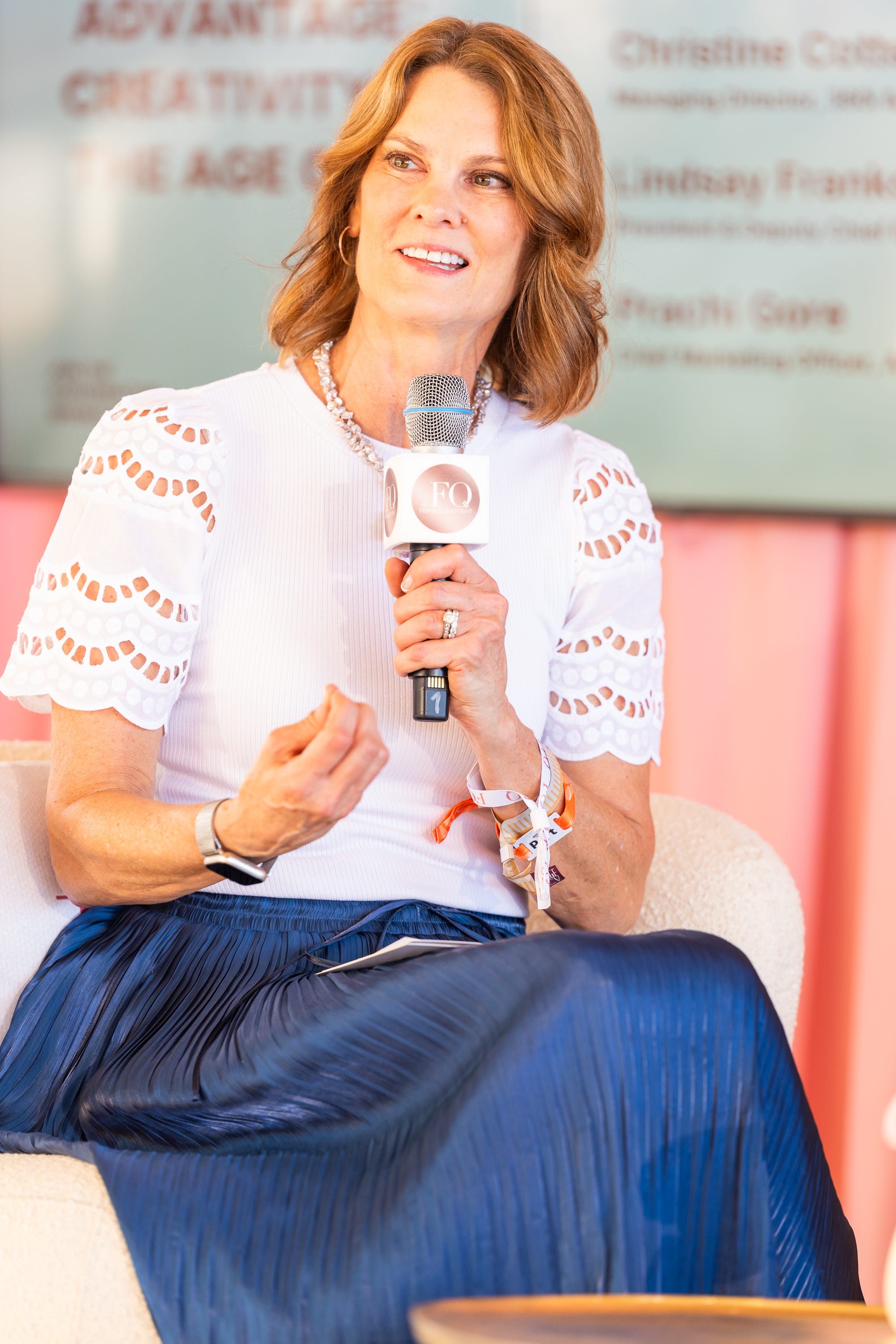
I had the huge honor of moderating a panel featuring executives from e.l.f., Ipsos, 360i and Asana at The Female Quotient’s FQ Beach. I just want to say, the FQ’s photographers are incredible!
I recorded a podcast about AI media with CMO Aaron Goldman on Mediaocean’s yacht (watch for the episode coming soon). Thankful for the high-powered fan they had going in between takes so we could cool off!

Beet.tv invited me to share my perspective on AI media and the power of AI platforms to intercept consumer intent. I also moderated a panel about the growth of agentic media buying with executives from OMD, Horizon and Chalice. Much appreciation to Andy Plesser, Lisa Granatstein and the terrific Beet.tv crew.

I added a bit of AI spin to a panel about pharma marketing and pharma retail media, alongside CVS’s Parbinder Dhariwal. Thank you Rob Rasko and 614 Group for the invite!

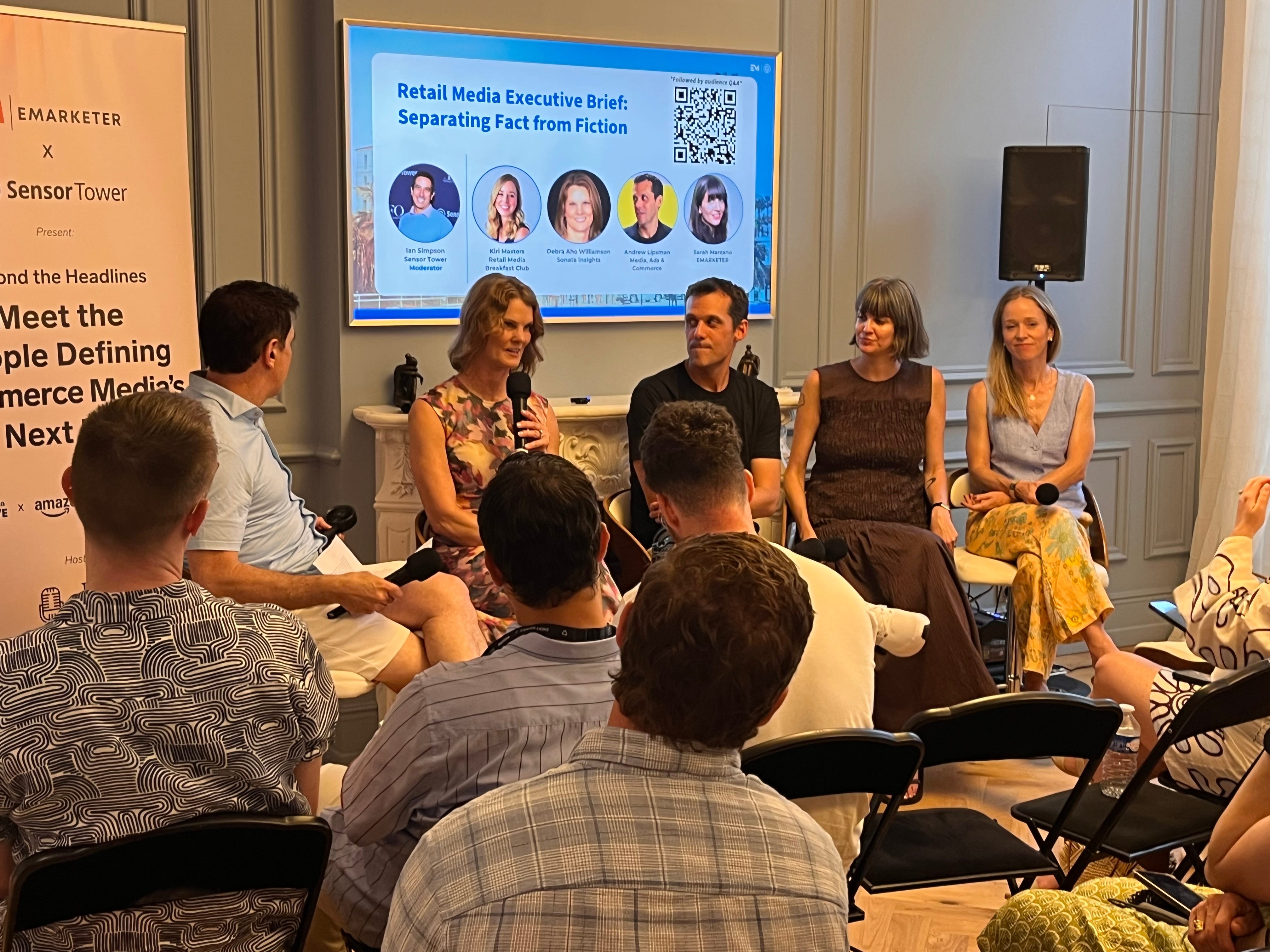
Finally, it was terrific fun to sit on a panel with my former EMARKETER colleague Andrew Lipsman, current EMARKETER analyst Sarah Marzano and Retail Media Breakfast Club writer Kiri Masters, moderated by Sensor Tower’s Ian Simpson. Thank you Sensor Tower for the invitation!
Debra Aho Williamson is the Founder and Chief Analyst of Sonata Insights, where she helps advertisers navigate the next major structural shift in media: the rapid rise and monetization of AI platforms. Over nearly two decades as an analyst at EMARKETER, Debra was among the first to forecast the growth of social media advertising and identify how it would fundamentally reshape marketing investment.
Today, she applies that same pattern-recognition lens to AI, analyzing how consumer adoption is accelerating monetization and redefining brand budgets, media strategy and industry power dynamics. Through Sonata Insights, she partners with leading platforms, agencies and technology companies to deliver research, advisory and strategic narratives that bring clarity and credibility to this transition.
Agree AEO needs more discipline, better evidence, and far less vendor mythology. But I don’t think the fundamentals have changed all that much.
Across the major LLMs, the same signals keep showing up: evidence, factual consistency, credible third-party validation, clear owned media, structured claims, expert authority, and content that directly answers real consumer questions. The models are not always as mysterious as the marketplace sometimes makes them sound.
Where I do think the industry risks going off track is when AEO becomes a game of marginal tactics — crawler tricks, Reddit hacks, prompt volume, schema fixes, and endless dashboards — rather than a discipline focused on serving consumers with better, more accurate, more trustworthy answers.
That’s probably my biggest disappointment in the current conversation: not enough focus on consumer utility and industry credibility. AEO shouldn’t just be about showing up. It should be about deserving to show up.
The ad-model question we often discuss/debate makes this even more important. Once answer engines begin blending organic confidence, paid placement, commerce incentives, and platform partnerships, marketers will need to distinguish trust from paid proximity.
So yes, demand more proof. But I’d separate the fundamentals from the frenzy. The fundamentals remain durable (we see this daily in endless audits): be findable, factual, useful, cited, consistent, and easy for machines to understand. Do I sound like a worn-record....or just what the doctor ordered? Happy Fourth! - pete